


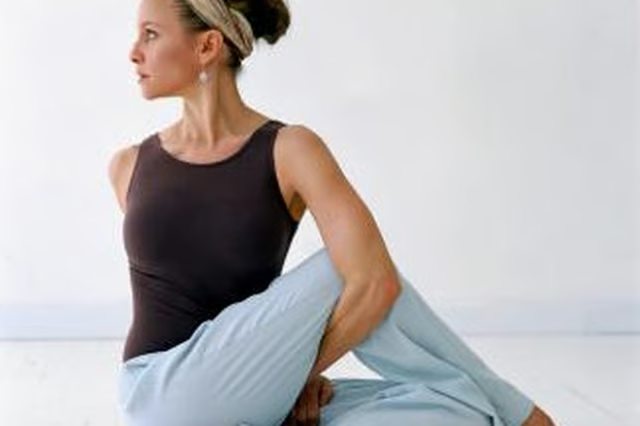
Stretching is important in keeping your muscles long and loose. Ideally, you should stretch after warming up with some light exercise so that you're stretching warmed muscles, which helps prevent injuries. But there's no "one size fits all" when it comes to stretching. There are seven primary types of stretching, each of which helps different people of varying flexibility and needs.
Static
Static stretching is the most commonly used type of stretching, and it's considered one of the safest because of the relatively low levels of tension required. With this style of stretching, you stretch a muscle or group of muscles to its furthest point, holding the position for 30 to 60 seconds. When you hold a static stretch, you should feel a gentle pull in the muscle or muscle group you're stretching, but you should experience no pain.
Passive
Passive stretching is similar to static stretching, the difference being that, with passive stretching, you don't supply the force to stretch a muscle. Instead, a stretching partner or outside apparatus does. For example, doing the splits is considered passive stretching, as the floor acts as the apparatus helping you stretch your leg and groin muscles. A partner pushing back your straightened leg while you're lying on your back would be another example of passive stretching.
Dynamic
The controlled leg and arms movements of dynamic stretching help you to gently push your muscles to the limits of your range of motion. In dynamic stretching, there's no bouncing or rapid movements; it's all slow, controlled movements, like gentle leg swings, arms swings or torso twists. Dynamic stretching can help improve your flexibility, and the style is effective as part of a warm-up before higher-energy active workout -- or even just to loosen up.
Ballistic
Ballistic stretching is similar to dynamic stretching. But ballistic stretching pushes your muscles beyond their normal range of motion. This style of stretching involves bouncing or jerking movements to force yourself into a stretch position. For example, a dynamic stretch would be repeatedly bouncing toward your toes to stretch your hamstrings. Dynamic stretching is not as effective as other styles of stretching, and it can also increase your chances of straining or tearing a muscle.
Active Isolated
Active Isolated stretching, also known as AI stretching, requires you to assume and hold a position with only the help of your natural muscle strength. For example, bringing your straightened leg high in the air while standing is considered an AI stretch. As one muscle contracts, the opposing muscle will relax, resulting in a better stretch. AI stretches can be challenging, so you won't need to hold a stretch like this for more than 10 to 15 seconds.
Isometric
Isometric stretching is a type of static stretching during which tension is developed without contraction of the muscle. This is achieved by getting a muscle into a stretched position, then resisting the stretch isometrically, typically with the help of a partner or outside apparatus. An example of isometric stretching would be having a partner hold your leg up while you try to force your leg back down.
Proprioceptive Neuromuscular Facilitation
Proprioceptive Neuromuscular Facilitation stretching -- which is usually, and thankfully, shortened to PNF stretching -- is less of a stretching style and more of a technique combining passive and isometric stretching in order to achieve maximum flexibility. Types of PNF stretching include hold-relax, contract-relax and rhythmic initiation. Originally developed as a method of rehabilitating stroke victims, PNF stretching has since become a common and popular treatment among many physiotherapists and other sports injury professionals.
