
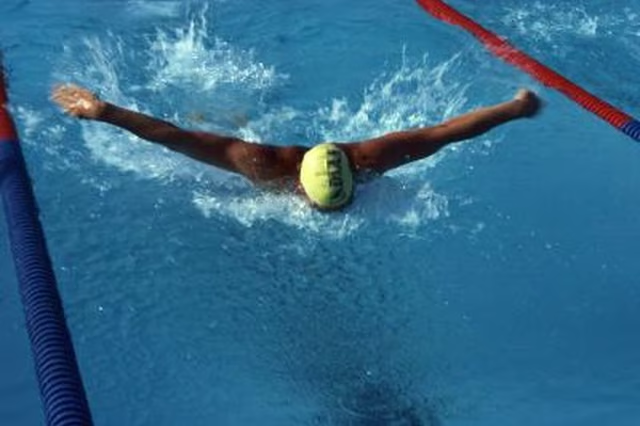
Swimming fast like a competitive swimmer calls for every muscle in your arms to be strong and for strong hands and shoulders as well. Your arms are responsible for reaching and pulling the water to move you forward in every swim stroke. The more arm muscle you have, and the more fast-twitch muscle fibers in your arms, which means you will have more power in your arms to propel you and you'll swim faster.
Muscles Required for Swimming
Swimming recruits all of the muscles in your arms, as well as your hands and shoulders. That goes for all four major swim strokes -- the front crawl, backstroke, breaststroke and butterfly. The muscles in your hands and forearms are used to push the water past you and propel you forward, while the biceps and triceps also push and control your arm movements. You also need strong shoulders, which include your deltoid muscles, so your arms can move and shoulders can rotate in a way that streamlines you for speed, propelling you forward efficiently.
Type of Strength Required
If you're aiming to be a better swimmer, you're aiming to be a faster swimmer. Muscles are made up of two kinds of muscle fibers -- slow-twitch and fast-twitch fibers. Strong slow-twitch fibers are needed for endurance during long swimming sessions, but fast-twitch fibers are responsible for explosive speed that can win a race. Fast-twitch muscle fibers can be strengthened by doing high-intensity intervals, where you do one lap at 80 to 100 percent of your maximal intensity, then a slow lap for recovery. You can also do strength training exercises for your arms -- like bicep curls, tricep kickbacks and so on -- with heavy weights for just a few explosive reps to build your fast-twitch fibers.
Front Crawl Cable Resistance Training
When swimming, the water resists your muscles to help strengthen your arms, but you can greatly increase the amount of resistance at the gym to build more muscle and recruit fast-twitch muscle fibers. A high pulley machine can work your arms and shoulders in the way you do in your front crawl stroke but with more resistance, making your front crawl stroke more explosive -- that means you'll be faster. Hold a handle grip overhead and pull it down and across your front to the opposite hip, then return to the original position and repeat.
Kipping Pullups
Kipping pullups are an arm exercise that improves your butterfly stroke. Hanging from a chinup bar, rather than going straight upward and downward like you would for regular pullups, do the body wave and kicking action you do during the butterfly stroke as you pull up and put your chin over the bar. This exercise strengthens all of your arm and shoulder muscles in a way that requires you to be rhythmic and smooth, like in swimming, Meanwhile, you strengthen the rest of your body for the butterfly stroke.
